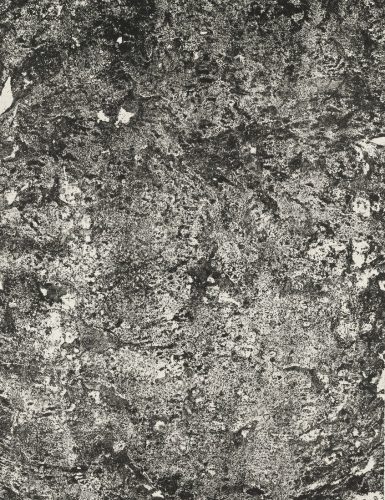
While the Mudec Museum in Milan is dedicating an exhibition to the Collection de l’Art Brut of Lausanne, Maroncelli 12 creates a dialogue between the Art Brut father and the Italian Outsider artists. Sols, Terres, the 18 lithographs from the Phénomènes series, created by Dubuffet in 1959, are coming to Milan to accompany the visions of irregular artists both historicized and contemporary, the protagonists of the history of Outsider art made in Italy.
In the mid-1940s, Dubuffet (Le Havre 1901-Paris 1985) aroused indignation for the provocative way in which he refused to accept the rules and shared values of academic art. For the French artist, culture is “harmful because it is not just information material”, but rather “a way of expressing oneself and thinking, a way of seeing, feeling and behaving”. And to deconstruct this system he turns to Art Brut, to the art of children and the mentally ill, to the self-taught, to “open the passage to the voices that come from the underlying layers”. In 1971 he donated his collection to the city of Lausanne, which opened the museum to the public in 1976.
Towards the end of the 1950s, when the adventure of the Phénomènes began, Dubuffet already had a substantial amount of work on matter behind him. His research is committed to a careful analysis – artistic, philosophical, aesthetic and symbolic – on the theme of nature, starting from a celebration of the soil and the earth. It is difficult to talk about proportion and symmetry when you assemble mud or a piece of crumbling wall; coal, gas, moss and lichen, to name just a few of the many materials used, become the subject of an incessant exploration where the surprise is continuous and the investigation almost scientific. These are imprints taken from different materials on inked transfer paper. Maroncelli 12 presents the 18 plates (the entire folder) of Sols, Terres, in the copy marked C (and signed by the author) printed for Giuseppe Raimondi. The ninth of the black and white albums of the Phénomènes series, this work was printed in 22 numbered copies plus three copies marked A, B, C, all on parchment. From the same period there are works on display by Pietro Ghizzardi and Carlo Zinelli, the only Italian Outsider already collected by Dubuffet. Also on display are Egidio Cuniberti, Martino Fiorattini, Franca Settembrini, Raffaele Capuana, Annamaria Tosini, Tarcisio Merati, Antonio Dalla Valle. Not only historicized authors but also contemporary Outsider artists such as Davide Cicolani, Umberto Bergamaschi e Paolo Baroggi. And directly from La Tinaia, one of the most prestigious Italian ateliers, Angela Fidilio, Giovanni Galli, Marco Raugei.
Egidio Cuniberti (1928-2006) wanders around the village, at night, to collect waste material, mainly fruit crates and his favorite sticks, ice cream sticks. He assembles them, cut, one on top of the other, obsessively, until he creates irregular furniture, small trunks but also paintings like bas-reliefs, landscapes like dreamed memories of his hometown.
Even Antonio Dalla Valle (1939-2020), a disconcerting character, almost a shamanic figure, navigated his world carrying a bag that he filled every day with discarded objects that were precious to him, lighters, pieces of plastic, adhesive tape, pens and notebooks. They all serve as material and inspiration for his “conceptual” works.
The farmer Pietro Ghizzardi (1906-1986) paints his “dolce vita”, Tarcisio Merati (1934-1995) his own personal and very free alphabet made of wonder and bright colors.
Franca Settembrini (1947-2003), the eternal child, paints strong girls, against the wind of history. The little priests, the animals, the glossolalia of Carlo Zinelli (1916-1974), like notes on a score, create a harmonious whole on the double-sided painted sheets. The painting of Raffaele Capuana (1947-2019) expresses a profound vision. The artist uses an exceptional freedom of expression to trace emotional coordinates, symbols of a daily life that is not always easy and happy.
Martino Fiorattini (1928-1997), cultivates melons until the age of fifty when he discovers his irrepressible passion for painting. And he begins to paint with thick brushstrokes, in dazzling colors, her environment: cultivated fields, wild animals, farmhouses and portraits.
From a jet-set protagonist to an elderly woman in a nursing home: Annamaria Tosini (1930-2013) instead of giving in to despair, in the last fifteen years of her life she invents worlds made of fragile sculptures of recycled paper, ribbons and feathers.
Traces, weaves, portraits, the works of Davide Cicolani (1978) are of great graphic power. His nomadic life has imposed as “necessary” the use of paper only. The important thing is that the sheets can be folded so that they do not take up too much space and they are easily transportable.
Umberto Bergamaschi (1954) seeks refuge in a silent and protected world: he draws his subjects inside a circle, stylized figures in a fetal universe where space and time do not exist.
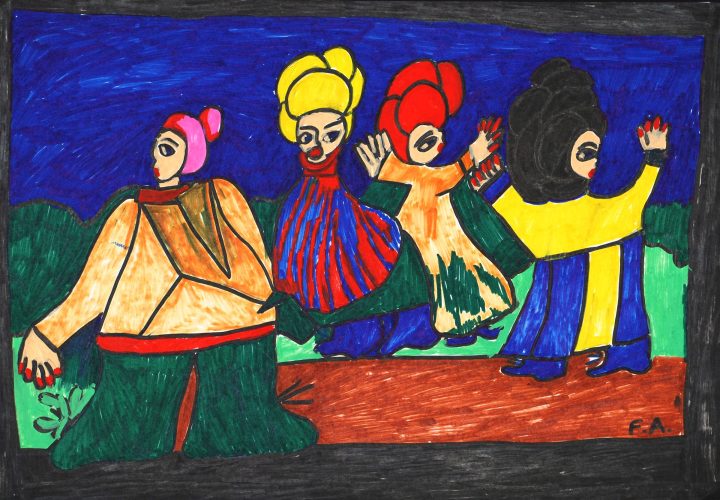
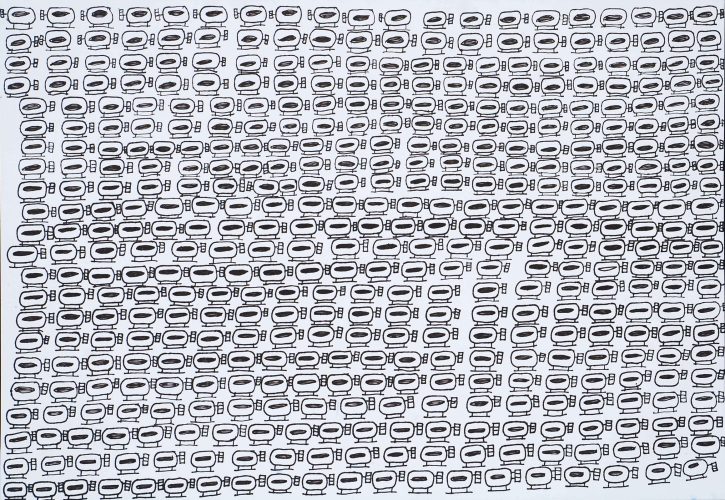
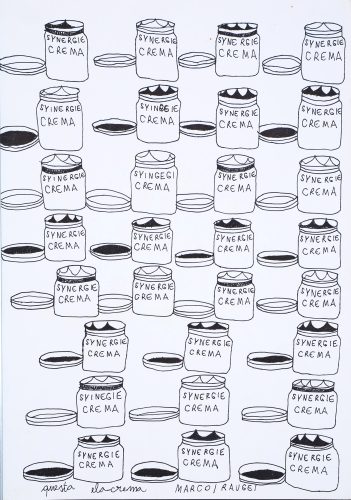
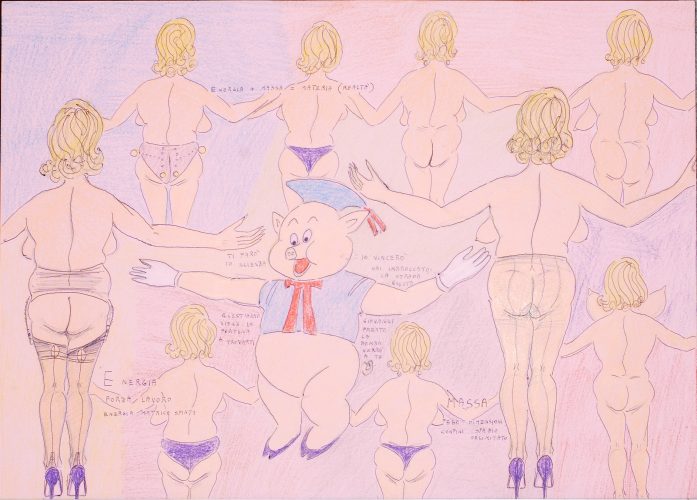
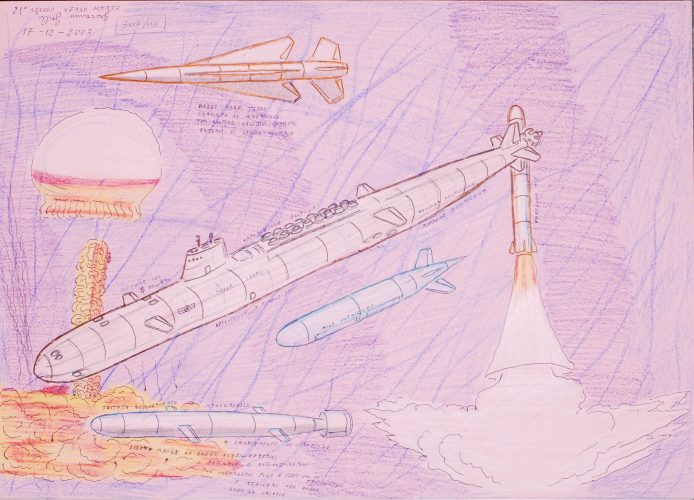
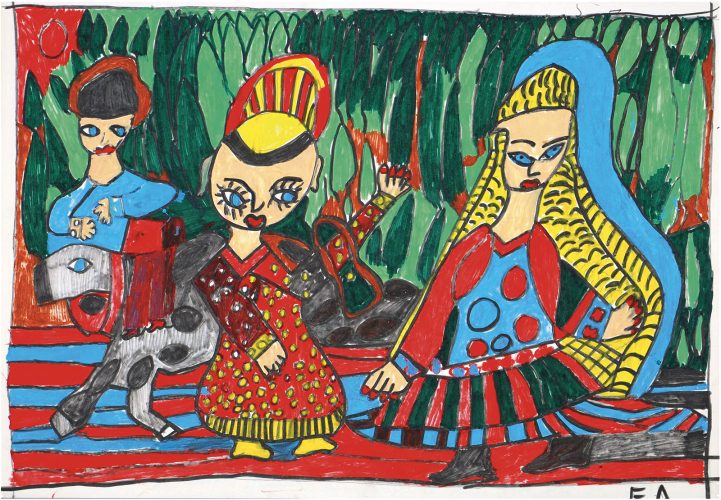
They have been frequenting the Atelier La Tinaia in Florence for years: Marco Raugei (1958-2006) draws the repetition of objects. From the cigarette packet, to the piano, to the clock, his “things” fill, almost as if to mark a rhythm, the space of the sheet. Angela Fidilio (1947-2018) tells of a fairy-tale world, in which starry skies, animals, real or imaginary human beings, have the power of enchantment. Planes, tanks, ships, female figures, divinities: Giovanni Galli (1955) accompanies his drawings with writings and phrases.
Galleria Maroncelli 12 – Milano
Copyright © 2024 – Tutti i diritti riservati